skip to main |
skip to sidebar
 It is difficult to judge a movie based on a book when you've read the book prior. Most faults or successes in the story in The Kite Runner must be attributed to the book's author. Take, for example, the ever-so-conveniently-appearing bad guy. It isn't the movie's fault that the character seems a bit trite.However, what can be accredited to the movie is the understanding of a powerfully emotional story and escalating the emotion to a quite moving movie. Having read the book before I saw the movie, I knew a bit of what to expect, but my co-viewers did not, and a certain someone was absolutely bawling for the last half hour.The Kite Runner is worth at least one viewing; it is truly a very good, possibly great, movie. Of all its successes, two stand out the most:Children Actors
The typical child actor is either super-annoying (reference The Sixth Sense) or just weird (reference Signs). Amir and Hassan as boys are one-hundred percent believable. The sacrifice and loyalty radiates off of Hassan, while the indifference and cowardice is made real through Amir. A typical viewer will aspects of his adult personality reflected in the two extremes of these kids. I have to keep reminding myself that they are indeed actors. In fact, adult Amir is so devoid of emotion that it makes the kid stand out even more.Squashing Everything InThe movie is barely over two hours, yet manages to expose the viewer to not only a superb story, but also glimpses of countries not often seen. Toss in a little history and great visuals (pomegranite tree), and you would have a great three hour movie. The fact that Kite Runner is able to do this in just two hours and still feel excellently paced is a credit to the film making.In short, prepare yourself to have a cathartic crying night, have a drink or two beforehand to help you out, and watch this if you haven't already. There are a couple lines that will stick with you. Highly recommended.The Kite Runner Rating: 90 / 100
Other Thoughts:
Hassan-Amir as a Christ-human metaphor (credit: Tiffany)
Amir's father -- easily the best acting in the movie.
Saddest part of the movie -- Amir's father leaves home expecting to return and never does.
 Like a 2-out single that sparks a multirun bottom-of-the-ninth comeback, John Wood's story is most exciting due to the couldn't-have-seen-that-coming factor. What started as a vacation turned into a small idea, which exploded into one of the coolest charities I've read about. In fact, I was so inspired by this story that I wrote to John Wood immediately after I was finished (requesting a job because we know where Sp... ah.. my company.. is headed).But what is the story?
In Leaving Microsoft to Change the World, John Wood is on a small sabbatical (in Nepal) from blossoming Microsoft. There, he discovers the country's intense need of books, libraries, and schools and its childrens' more intense desire to learn. He promises to return with books (on top of the pictured yak). What follows is an absolute eruption of giving from John's friends and family. Funding and providing books for one library soon turns into John leaving his killer position at Microsoft to work on his charity full time. Now, Room to Read (the charity) is present in seven countries in Asia and Africa building libraries, schools, and funding education.Not just a success story...
Perhaps the part I enjoyed most about the book is that it does not only talk about how his charity started, but it discusses entrepreneurship, management theories, and other business ideas. It seems that business lessons learned by John apply strongly to successful for-profit organizations as well. Perhaps what stands out the most is how lean, focused, and passionate his company is.Anyone can do it
As long as you've, you know, worked at a skyrocketing tech company, have millions of dollars of stock options, and the ability to quit receiving a salary for years at a time and still travel to third world countries. Admittedly, the author talks about how anyone can get involved, but it sure makes following your dreams easier when you've got the money to do so."It will make you want to quit your job."
Well, I was warned (Jeff) before I started to read that it would make me want to quit my job. It's true, a social improvement job is a lot more appealing than SQL. Leaving Microsoft starts out interesting and only improves. It is not a particularly difficult read, either, so that, coupled with how much fun it is to see Room to Read succeed makes this a rather quick read. At best, you'll be inspired to "dive in" (the author's words); at worst, you'll be entertained for a couple hours' worth of reading.Leaving Microsoft to Change the World Rating: 84 / 100Writing Style: 7 / 10
Finish-the-chapter-before-bed Factor: 8.5 / 10
 Five minutes into Becket I realize that .... oh no ... yes, that is an over-the-top monologue being delivered by Peter O'Toole. This isn't a movie; this is some ... play ... that has been marketed to me as a movie in some terrible prank. Becket, essentially a character study of King Henry II and Thomas Becket, is interesting, although a little talky, overacted, and generally play-like.The 1964 film focuses nearly completely on the two main characters and their friendship-turned-rivalry in 12th century England. In short, the movie depicts the historical appointment of Thomas Becket as Archbishop, a position King Henry counts on to be in his pocket. Once appointed, old hunting-pal Becket realizes that, hey, maybe there is a loyalty greater than to a king, causing the pair to become at extreme odds. The story (and history) ultimately ends with the assassination of Becket, who becomes a Christian martyr. Complaint 1: Overacting
As the movie begins, it's actually kind of funny to watch Peter O'Toole act completely over the top. It is the kind of acting that would be acceptable in live theater, but comes across as annoying on film. I am in no way discounting his acting talent; a good amount of the movie is enjoyable to watch him dominate the screen and other actors as if they were high school drama students in the same room as a legend. But, near the end of the movie, it started to get on my nerves.(One of my favorite parts is when King Henry's bitter wife remarks that "we perform to the best of our abilities." It almost seems like a tongue-in-cheek remark about O'Toole's acting).Complaint 2: Yadda yadda
Once a scene is set, the players are pretty much set... COMMENCE DIALOGUE. And a lot of it. Again, very play-likeNo More Complaints
To be fair, the movie is over 40 years old. I'm not expecting awesome visuals and accompanying soundtrack. But, I do think that the movie could benefit from a faster pace and greater exploration of the rift developing between Becket and the king. It seems as though they are awesome friends for 45% of the movie and rivals for 45%, leaving only a tenth for their relationship to dissolve. I should pause and note that while I keep talking about their relationship seemingly go from white to black, the actors do a superb job conveying that there are many, many levels to their characters' relationship. King Henry several times talks about how much he loves Thomas in the same sentence as when he talks about how much he hates him. In the same vein, the viewer sees Thomas torn between two loyalties.Conclusion
I am a sucker for medieval anything, but it is difficult for me to recommend Becket unless you really know what you're getting into: a mildly interesting, talky play-film.Interesting Side Note
One of my favorite books, The Pillars of the Earth, also deals with the assassination of Thomas Becket, from a much different viewpoint. Becket adds another dimension to the story -- to the point of making me want to re-read the book.
Becket Rating: 60 / 100
Other Ratings:
Acting: 8.5 / 10
Soundtrack: 3 / 10
Interest-Level: 6 / 10 at the beginning, waned to 3 / 10
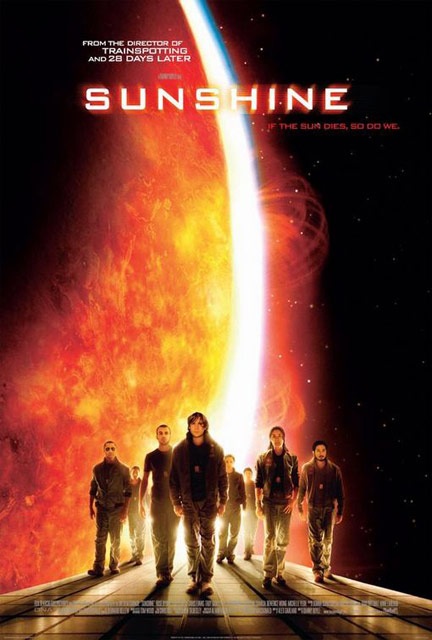
 Sunshine seems to have been created as part of a contest to see how many genres a director could fit in one movie. It's got its summer blockbuster special effects, its sci-fi atmospheric thriller moments, and even some slasher horror bits thrown in.
If only Sunshine's director Danny Boyle could pick one and stick with it, the movie could have been really good. As it is, though, Sunshine is a jumble. A really good-looking jumble.
The movie starts with such promise. It has a cool back story and enough science to satisfy and facilitate the suspension of disbelief. (The premise, and this is not a spoiler, is that Earth is slipping into an Ice Age due to a weakening and eventual extinguishing of the Sun. Eight astronauts are sent on a rescue mission to create a supernova of sorts -- to set off an explosion in the Sun and create a new star).
The beginning visuals are quite stunning, especially on a nice TV. There are frequent shots of the Sun, Mercury, and the outside of the spacecraft. And while the ship is cool to explore, the viewer begins to get a sense of dread. This is when the movie launches into its atmospheric thriller mode.
Something about space lends itself to the atmosphere of dread. Of course Alien is the standard most atmospheres are compared to, but this movie also reminded me of Descent. It must be the closed-off nature of space (and caves). Again, Sunshine succeeds. I was getting edgy watching by myself. The first time you see a subliminal image, yes, it really is there. I rewound frame-by-frame to see what the picture was, the whole time feeling like I was in a thriller myself, about to be shocked by the horror this freeze frame would contain.
This sense of dread is multiplied a hundred times when the crew is forced to investigate an abandoned spacecraft (the original mission that mysteriously failed seven years prior). I was fully prepared to be creeped out -- not startled by GOTCHA! horror. And that's where the movie begins to fall apart. All of a sudden, it turns into almost a slasher movie, complete with chases through dark hallways and stabbings.
From this point on, the movie spirals a bit out of control, although not terribly so. Chase scenes are interspliced with stop-action blurry shots of who-knows-what. The movie eventually paints itself into an ending you knew was coming, and one that leaves no room for a twist. It is a shame the movie becomes so muddled, because it had a chance to be an absolutely great sci-fi flick. (Something that The Core, for example, gave up two minutes into the film).
Sunshine is worth a see. Just don't expect too much.
Sunshine Rating: 75 / 100
Subratings
Soundtrack: 8 / 10 (surprisingly good, but one of the stranger choices for the end credits)
Acting: 7 / 10 (never felt very attached or invested in any characters, though they are forced to make some tough choices)
Sci-Fi Backstory: 7 / 10 (whole lot better than The Day After Tomorrow)
 Imagine Dan Brown, amidst writing his historical...ish... novels tore out all the uninteresting and predictable parts and tossed them on the floor, where they were later collected by migrant birds, who built a nest out of the scraps. Years later, after some of those pages were lost, some editor came back and took the nest and published it.
This is how The Last Templar came to be. History proves it.*
I unfortunately did not get to read reviews for this book, as I picked it up at the airport in Reno when I had run out of reading materials. I'm a sucker for medieval storytelling, so what the heck.
Man, what a mistake. The book's biggest problem is straightforward, cookie-cutter characters. Characters like this then lend to trite, hackneyed dialogue.
The premise of the book is this:
Four masked men steal a strange Vatican artifact while it is on displayed at the Met. This leads an investigator... a beaten-down, Catholic-background, trying-to-do-the-right-thing investigator (a Bruce Willis character if there ever was one)... to team up with a girl-power, know-it-all, secular archaeologist to hunt down this artifact. The fate of the Catholic church (and the world, the book assumes) hangs in the balance. Every cliche character the author can manage is squeezed in, including the power-hungry Catholic official and the old man wronged by the church who's back with a vengeance.
The story manages to be both boring and straightforward. Pretty much every event happens as you would expect it. The dialogue is awful. Sentences are broken up to be dramatic. Like this. It's as if the author wanted a Law & Order dun-dun after every chapter (which just happen to be modeled after Dan Brown's two-page, oh-you're-reading-so-much chapters). Want some examples?
"Sitting in the second boat, watching them with a look of muted delight . . . was William Vance.
He was cradling a shotgun."
. . . . .
DUN-DUN
---
"There in front of her was a brick wall.
It was a dead end."
. . . . .
DUN-DUN
So we come to the worst part of the book: the MOST formulaic, the MOST smug, the most oversimplified. I'm about to ruin the story, but I'm saving you $12 and a world of literary hurt. The female protagonist finds the artifact that could dismantle the entire Catholic church. But... she was just rescued by these kind islanders, who happen to be ... Catholic. They also happen to be poor fishermen who live on an island with their kindly, gentle fishermen wives. They are the only characters in the book who don't speak English, and they attend a whitewashed, homely cathedral from centuries past. I swear I am not making this part of the story up.
So when the main character gets her chance to reveal the Catholic faith for the scourge it is, she thinks about these kind villagers, at which point, she tosses the artifact into the ocean. She can't bear to unveil to these poor ignorant fishermen the truth behind their faith because, well... because they're so nice!
The Last Templar is awful. Please don't read it, unless you are willing to buy my copy.
The Last Templar Rating: 21 / 100
Subratings:
Story Idea: 4 / 10
Writing Style: 2 / 10
Excitement Level: 3 / 10
*Just as history has proven The DaVinci Code.
 Once is another movie that my friends got me really excited to see. (Previously, I had been told that Reign Over Me was better than a ten point scale could ever express. Big disappointment).
First off, I hate musicals. I say this never having seen an entire one. That being said, this is not the type of musical that has actors spontaneously bursting into song. Rather, it almost seems like a documentary on a songwriter.
By this, I mean that Once really gives an excellent feel of Dublin and its locals. When they are singing, it isn't because they are in a movie that is a musical; instead, it is because they're all... well... musicians. Each time a song is played, it seems extremely realistic.
Therein lies an interesting part of the movie, though. Even though the singing seems very natural, it also serves to develop the story -- not by explaining plot, but by explaining the history and feelings behind characters. This can be tough, because you're almost obligated to try to decipher the songs. As soon as I started just enjoying the music without trying to comprehend lyrics, I thought -- shoot! -- I'm missing dialogue.
The initial meeting of the guy and the girl is awesome. The actors (or musicians) truly click, and the viewer sees what could be the start of any romance in any other Hollywood flick. The not-quite-romance is a joy to watch begin. But, it never seems to get past this initial point.
If one of the movie's taglines is in regards to how often you find your soulmate, then I really wish that point had been pushed harder. While they were cool to watch with each other, I never got the sense that the guy and the girl were meant for each other. For whatever reason, in my mind, I was comparing the couple to the couple in Good Will Hunting. In that movie, I really got the sense that Will would have fought for his girl. Not in Once. Maybe with some expanded run time, this could have happened.
Oh -- I thought of a better example. Johnny Cash & June Carter in Walk the Line. The initial meeting is just as cool as the one in Once, but the viewer really sees the relationship develop into something where both Johnny and June are willing to fight for one another. In Once, honestly, I just feel like the guy and girl are wondering "what could have been," instead of pursuing being together. Maybe that was the point of the movie.
All considered, Once is definitely worth a watch. Rather than watch it again, though, I would be more likely to listen to Glen & Marketa's album (which is called The Swell Season).
Once Rating: 79 / 100
Subratings:
Acting: 6/10 -- I realize they are musicians first, actors second
Music: 9.5/10
"Feel" of the movie: 9/10 -- I really enjoyed the documentary-ish feel of the movie
 After finishing No Country For Old Men no less than ten minutes ago, I wanted to get my immediate reactions down on virtual paper as soon as possible.
And my very first thought, however minute: Did that movie have ANY music? At all?
Overall, my immediate reaction is that it is a good, but not great, movie. Is it symbolic or just trying to be symbolic? I mean, I am no slouch in the literary devices department, but the allegory at the end of the movie left me curious. Not bewildered, but definitely curious. I even rewound it once to try to get my head around it.
Is there a "good guy" in the movie? Who are we pulling for? I at first thought Llewelyn was a bit of "that guy," but maybe it is Ed Tom. Heck, maybe it's no one, which is something I feel like I've been seeing a lot lately (There Will Be Blood?). I've heard that in the book (the movie's basis, naturally), Ed Tom is a bit more of a main character, as compared to the movie, which felt to me, like a struggle between Chigurh and Llewelyn. To me, it would have been nice to have the viewers pushed more toward rallying around the sheriff at the beginning, because the movie closes around him (and thematically, seems to be about him). Instead, the typical viewer is (understandably) obsessed with Chigurh's visceral killings -- even though Ed Tom technically opens the movie.
A definite cool part of the movie is the ability to generate a lot of good discussion around it. In fact, the more I just think about the movie, the more questions I have, highlighted by this: "What was Chigurh's motivation the entire movie?" (Or was he just insane?). Perhaps Chigurh serves the purpose of pushing forward a main theme of the movie: justice.
My least favorite part -- the Lady or the Tiger throwback with Carla Jean. Gosh, just tell me what happens.
To pick one word to summarize this movie: "deliberate." Every action, piece of dialogue, and glimpse of scenery felt completely purposeful and almost expected. No Country is interesting, definitely worth a watch, but I feel like this tried too hard to be too deep. (I've been warned about this -- Nathan -- so we'll see if my opinion changes).
No Country For Old Men Rating: 82 / 100
Subratings:
Acting: 9/10 (minus a point for Carla Jean)
Scenery, "Feel" of being there: 10/10
Soundtrack: Yeah, okay
 It is difficult to judge a movie based on a book when you've read the book prior. Most faults or successes in the story in The Kite Runner must be attributed to the book's author. Take, for example, the ever-so-conveniently-appearing bad guy. It isn't the movie's fault that the character seems a bit trite.